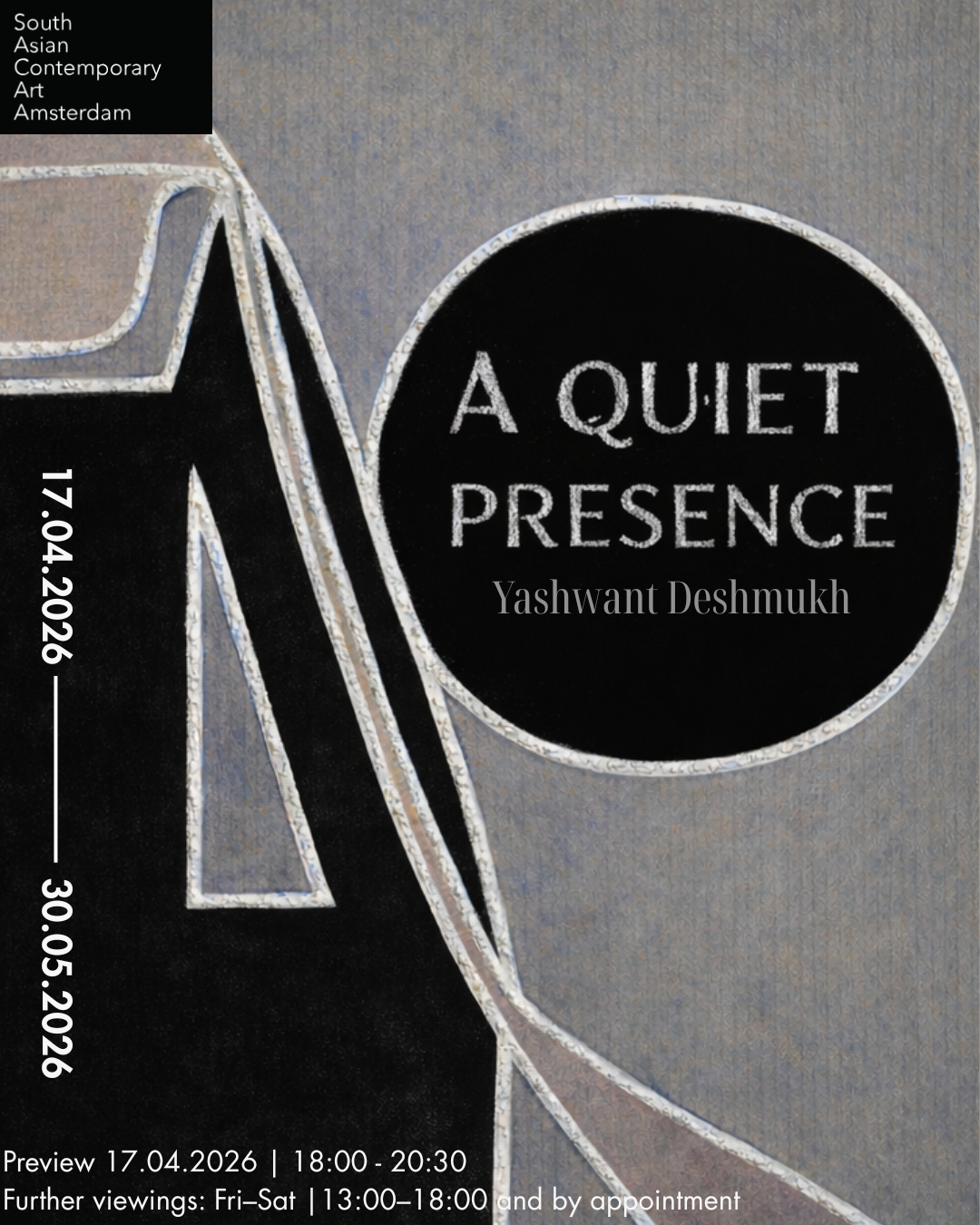
A QUIET PRESENCE
17.04.2026 – 31.05.2026 | Yashwant Deshmukh
Through a language of restraint, the paintings of Yashwant Deshmukh reveal themselves gradually. Forms emerge within subdued fields of colour, held in a delicate tension between appearance and withdrawal. Nothing in these compositions demands immediate attention. Instead, they invite a slower mode of looking, in which perception adjusts to subtle shifts in line, tone, and spatial balance.
Presented in Amsterdam, these works enter a context long attentive to light, atmosphere, and the quiet drama of observation. Within this setting, Deshmukh’s restrained pictorial language resonates with traditions of careful looking and the subtle interplay between object, light, and space.
Deshmukh begins with familiar shapes drawn from everyday life. Yet these images move far beyond the conventions of still life. Released from their utilitarian context, the forms hover between object and sign, between recollection and abstraction. As the artist notes, “My painting is not about shapes. It is about space.”
The shapes originate in the vocabulary of the ordinary, but they are no longer treated as objects of use. They become spatial markers-forms that register direction, weight, and balance within the pictorial field.
Line and contour form the quiet architecture of the work. Horizontal lines settle the image, verticals introduce balance, diagonals create tension, and curves allow the forms to breathe. These gestures unfold within restrained tonal fields– dusty greys, muted browns, diffused blues, where images appear suspended between object and abstraction.
Encountering these works is almost like reading a poem. In poetry, the line shapes rhythm and attention, while the blank space around it carries equal weight. Meaning emerges through pauses and intervals. Deshmukh composes his paintings with a similar sensitivity: a single contour guides the eye while surrounding tonal fields allow space itself to become as present as the form it contains.
Critic Ranjit Hoskote has described Deshmukh’s paintings as explorations of the “life and afterlife of objects,” where humble forms move beyond description and acquire an unexpected intensity of presence. A vessel may recall the silhouette of a mountain, a contour may echo the arc of a horizon.
Traces of the landscapes of Vidarbha in Maharashtra, where the artist spent his childhood, continue to echo within these compositions: vast plains, shimmering heat, and horizons dissolving into haze.
‘A Quiet Presence’ gathers paintings that reward sustained attention. Their power lies not in spectacle, but in the gradual unfolding of image and atmosphere. What remains is not the image of a thing, but the experience of its presence.